
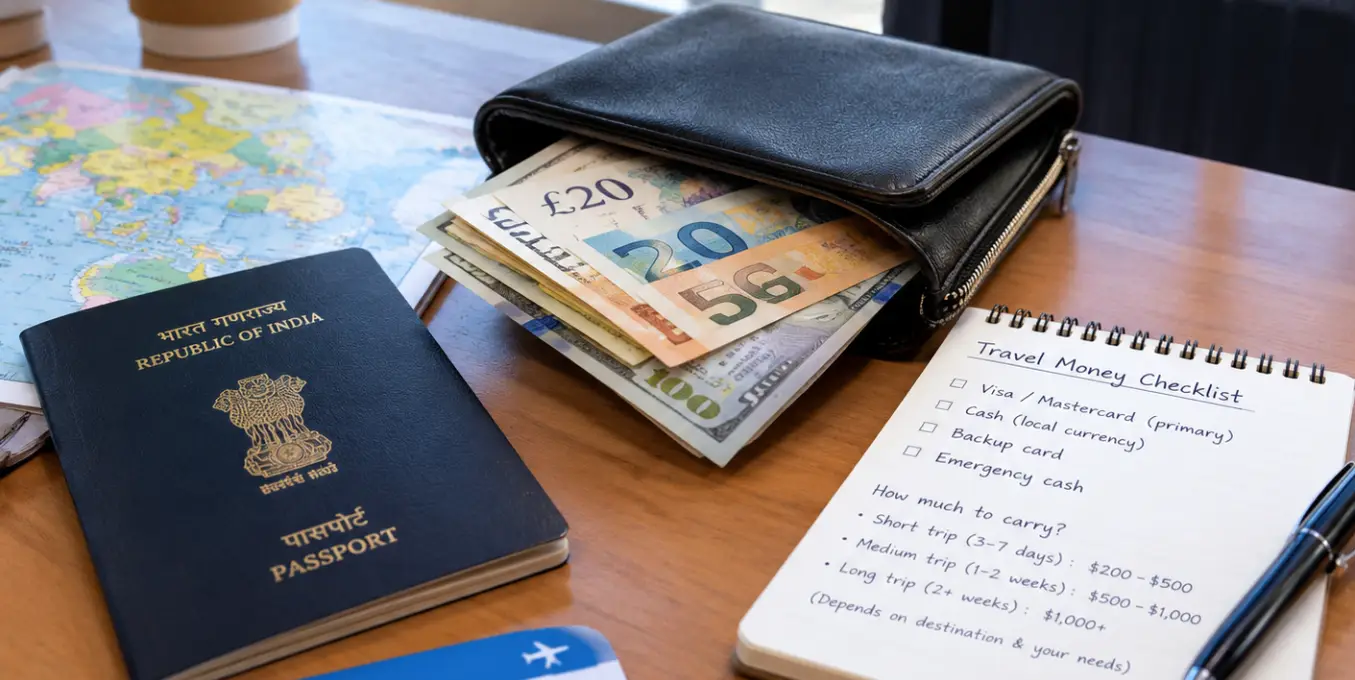
As you are preparing for your travel overseas, one problem comes to your mind again and again. That is how much foreign currency you should carry? It is quite natural. If you do not carry enough foreign currency, then you have to look for ATMs in a city that you do not know about.
On the other hand, if you carry too much foreign currency, you are risking yourself by carrying too much cash that is not necessary.
However, a little research into the currency exchange will help you in solving this problem. It can be regardless of whether you buy foreign currency from home in Panchkula or buy it just before your departure.
The required amount of foreign currency does not depend upon any travel forums’ post but depends upon your destination and trip duration.
Once you know that, the rest gets simple. Here’s how you can work it out for your own trip, and why each factor actually matters.
What Decides How Much You Should Carry
Your ideal amount changes based on a few real factors, not guesswork. Getting your foreign currency exchange wrong in either direction costs you money or peace of mind, so it helps to understand why each factor moves the number.
- Destination cost of living.
A daily budget in Bangkok stretches much further than the same amount in Zurich. Countries with a weaker cost base mean you need less converted cash for the same experience, while high-cost cities push your daily spend up fast.
- Is the country card friendly?
Cities like Singapore or Dubai run on card payments almost everywhere, so you can hold back on cash. However, smaller towns in Southeast Asia or Eastern Europe still expect cash for local transport, small vendors, and tips, so you need more on hand.
- The no. of days of your trip.
Your daily forex needs multiply with each extra day, but longer trips don’t need a straight multiplication. You can top up locally with a card instead of carrying everything upfront.
- Type of activities planned.
Street shopping, food markets, and local transport eat into cash fast. A fully prepaid tour with meals and transfers included needs far less loose currency.
Once you weigh these against each other, you land on a number specifically factored for your actual trip, not a generic average pulled off a blog.
That said, it is important to note that getting your foreign currency exchange amount right at this stage saves you from either scrambling for cash abroad or carrying dead weight in your bag.
Know Your RBI Limits First
Before you decide on an amount, you need to know what you’re legally allowed to carry and why that limit exists in the first place.
India regulates outward forex through the Reserve Bank of India’s Liberalised Remittance Scheme (LRS), which caps how much foreign currency an Indian resident can take out per financial year for travel, education, and related purposes. This exists to track capital leaving the country and prevent misuse of foreign exchange for unauthorised purposes.
Within that annual cap, there are separate sub-limits for how much you can carry as physical cash versus load onto a prepaid forex card versus route through card payments.
Furthermore, customs rules also add a layer. Carrying foreign currency notes above a set threshold without declaring them at the airport can trigger scrutiny, even if the amount falls within your LRS limit.
Therefore, it is important that you know these numbers before you book your currency exchange and follow all the rules as required. It will help you not get any last-minute surprises at departure or arrival.
The Smart Split: Cash, Forex Card, and Backup Card
The majority of experienced travellers do not use a single form to carry their money. It may sound weird, but the reason behind it is that each one is designed to cover a different risk.
- Cash for immediate expenses
It comes in handy in many ways. For example, airport transfers, tipping, making small local purchases, and in cases when no card machine will work. It acts as your safety cushion until you learn how things are done locally.
- A forex card for the bulk of your budget.
It locks in your exchange rate at the time of loading, so later currency swings don’t affect what you’ve already converted. It also keeps your travel funds separate from your main bank account. As a result, it limits your exposure if the card is ever compromised.
- One backup international card.
You should keep it aside specifically for emergencies, in case your forex card gets blocked, lost, or runs low unexpectedly.
This is important since risk gets isolated as well. If you lose your money, it does not take away from your entire travel budget, while the foreign exchange card getting blocked will not leave you without a payment method. The choice of exchange will be independent of one variable.
Talk to an Expert for Currency Exchange Guidance
Get transparent rates, avoid hidden forex charges, and plan your currency exchange smartly before travelling abroad.
Call Now for Currency Exchange AssistanceHow and Where to Exchange Your Currency
Once the amount of money is known, the other aspect is deciding on how and where to exchange foreign currency.
Time plays a major role in this process. Since the rate changes on a daily basis, it is advised that you secure your foreign currency exchange a day or two ahead of your travel date.
Checking the rates from different sources will also keep you away from getting into a bad rate bargain whenever you want to exchange foreign currency.
The choice for currency exchange would mostly be one of the following:
- Banks
These will always offer safety and security, but can be relatively slow, and have fewer currency types available.
- Airport exchange booths
These are easy and convenient as you go near the boarding time of your plane, but the costlier of all options.
- Authorised Forex dealers
This is the most preferable of all options.
For example, if you’re based in the Tricity area, we at Unipay Forex, one of the leading currency exchange Panchkula service providers, let you lock in your rate in advance and collect your currency without airport markups.
Picking the right source for currency exchange matters as much as picking the right amount, and knowing where to exchange foreign currency ahead of time keeps your last day before departure stress-free.
What To Do With Leftover Currency After You’re Back
Usually, you do not exhaust the entire currency on your trip. When you come back home, there will still be some currency left, and it needs to have its fate decided.
In other words, it’s important to know the correct way of exchanging foreign currency back into local money. The procedure of how to exchange foreign currency into Indian rupees is very simple. You give your notes to an authorised agency or bank, which checks the currency and exchanges it.
Rates for converting back are usually slightly different from what you paid, so don’t expect an exact match when you go through how to exchange foreign currency to Indian rupees at the end of your trip.
Unipay Forex offers this as a dedicated Sell Forex service, so you don’t need to hunt for a separate dealer just to convert your leftover currency back.
Keeping your exchange receipt from your original currency exchange makes this reconversion faster and avoids any documentation back and forth.
Talk to an Expert for Currency Exchange Guidance
Get transparent rates, avoid hidden forex charges, and plan your currency exchange smartly before travelling abroad.
How Can Unipay Help?
Unipay Forex has most of the things that you will require for forex transactions, all under one roof:
- Purchasing and selling of forex transactions at competitive rates that are visibly displayed, whether you plan your outbound forex transaction or convert back later.
- Forex cards for secure transactions abroad in several currencies.
- Reconversion support for leftover currency once you’re back, covering how to exchange foreign currency to Indian rupees without extra hassle.
- Local pickup and doorstep options for customers in Panchkula and the wider Tricity area, making Unipay Forex a convenient Currency Exchange Panchkula option so you’re not stuck depending only on airport counters.
Working with one trusted Unipay Forex partner for both the outbound and return leg of your currency exchange needs takes one more thing off your travel checklist.
Quick Checklist Before You Travel
Before you head to the airport, run through this:
- Confirm your RBI/LRS limit for the trip.
- Decide your cash-to-card split based on your destination.
- Book your currency exchange 1 to 2 days in advance, not last minute.
- Carry a valid ID and keep your exchange receipt safe.
- Note your forex card’s helpline for lost or blocked card situations.
Ticking these off means one less thing to worry about once you land.
Final Word
So how much foreign currency should you carry? Enough to match your destination, your trip length, and your spending style, split sensibly between cash and card.
Check your RBI limits first. Decide your cash-to-card split next. Book your currency exchange a couple of days ahead, not at the last minute. And once you’re back, remember your leftover notes can be converted too.
Get this sorted early, and your trip planning gets a lot lighter. If you’re in the Tricity area, Unipay Forex can help with the entire process, from your first exchange to your last.